What is zellige?
Last updated: October 4, 2026
Zellige — also written zellij or zillij — is a mosaic made of small pieces of glazed terracotta, cut one by one by hand and fitted together into geometric patterns. It covers walls, fountains and floors across Morocco and once flourished from al-Andalus to Algeria and Tunisia.



Where the name comes from
The word comes from the Arabic zalaja, “to slide”, a nod to the smooth glazed surface of the tiles. The Spanish and Portuguese word azulejo is thought to come from the same root.
A short history
- 10th–11th century. Glazed tile mosaics appear in the western Islamic world, probably inspired by Byzantine mosaics. Early fragments are known from al-Mansuriyya, in today’s Tunisia, and from the Qal’at Bani Hammad in Algeria, with eight-pointed star tiles.
- 12th century. Under the Almohads, bands of green and white ceramic decorate minarets in Marrakesh.
- 14th century. The golden age. The Marinids in Fez and the Nasrids in Granada build complex panels; the Alhambra uses pieces only a few millimetres wide, even to spell out inscriptions. Blue, green and yellow join the original white and dark tones.
- 16th century and after. The Saadians fill the tombs and madrasas of Marrakesh with zellige. Morocco keeps the craft alive without interruption, while Spain moves to moulded tiles and Tunisia and Algeria largely turn to painted tiles.
How it is made
- Clay — in Fez, a grey clay from the region — is shaped into squares about 10 cm wide and fired.
- The squares are glazed in a single colour and fired again.
- A cutter, working by eye, chips each square into precise shapes (stars, crosses, almond-shaped pieces) with a small sharp hammer.
- The pieces are laid face down on the ground, forming the pattern in mirror image.
- Mortar or plaster is poured on the back. Once set, the panel is lifted, turned over and fixed to the wall: the pattern appears only at the end.
Colours
The oldest zellige plays on white with dark brown or black. Blue, green and honey yellow spread in the 14th century, and red arrives later. Because every piece is glazed and fired by hand, each one varies slightly in tone — that unevenness is what gives zellige its shimmer.
The geometry
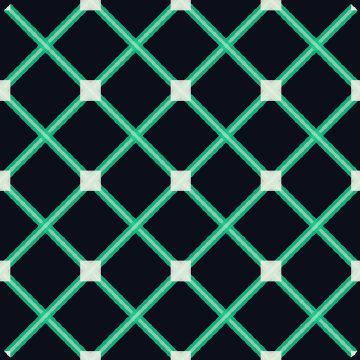
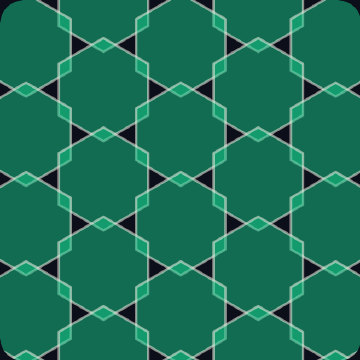
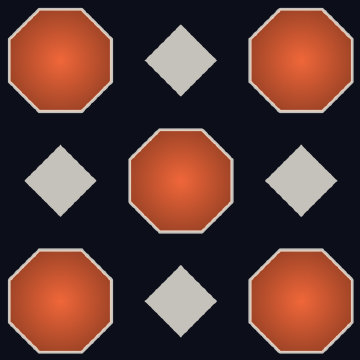
Zellige patterns are tessellations: shapes that cover a surface with no gaps. They grow from regular polygons and star polygons — 8-pointed stars (the khatim), 12- and 16-pointed rosettes — joined by crosses, hexagons, octagons and endless interlaced ribbons. The same small set of shapes, repeated and rotated, produces patterns that seem to have no beginning and no end. These tilings later fascinated the Dutch artist M. C. Escher.
Where to see it
- Bou Inania Madrasa, Fez (14th century)
- The Alhambra, Granada (14th century)
- Ben Youssef Madrasa and the Saadian Tombs, Marrakesh (16th century)
- Hassan II Mosque, Casablanca (20th century, traditional designs)
Zellige today
Fez is still the main centre of production. Master craftsmen — the maâlem — pass the skill on through long apprenticeships, often around ten years before a cutter becomes a master. Zellige now also decorates modern kitchens, bathrooms and hotels far beyond the Maghreb.
From tiles to a game
ZELLIJ · Mosaic Drop turns this idea into a puzzle: every chain of gems you burst fills a zellige frame, and each completed frame adds a motif — an 8-pointed khatim, a 16-point rosette, a Fez interlace — to your heritage album.
Get ZELLIJ on Google Play About the gameSources: Wikipedia — Zellij, and museum and workshop presentations of the craft.